In the world of custom packaging, printing is a key step that gives your brand its unique look. However, some custom printed bags, printed packaging bags, or custom plastic bags may have a slight ink smell right after production. This can affect the unboxing experience and might even make customers question product quality. So, how can you effectively reduce or remove these leftover ink odors? This article offers practical solutions in two stages: during production, and after the customer receives the goods.
How to Eliminate Ink Odor During Production
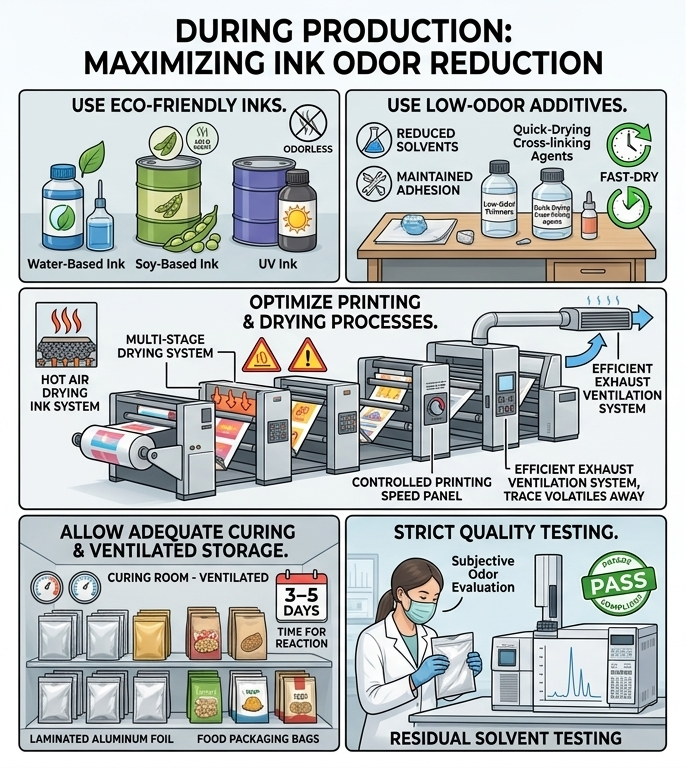
The most effective way is to control the problem at the source. As an all-in-one custom packaging solution provider, we take the following steps during production to minimize residual ink odors.
1) Use Eco-Friendly Inks
Traditional solvent-based inks are the main source of odor. We recommend and prioritize:
Water-based inks: These use water as a thinner, have very low VOC (volatile organic compound) content, and are almost odorless after drying.
Soy-based inks: Made from renewable soybean oil, these have a mild smell and are more environmentally friendly.
UV inks: These cure instantly under ultraviolet light, do not penetrate the material, and release no solvents, resulting in very low odor.
These eco-friendly inks not only significantly reduce bad smells but also meet the growing demand for sustainable packaging, helping to enhance your brand image.
2) Optimize Printing and Drying Processes
Even with eco-friendly inks, if drying is incomplete, leftover additives can still create odor. Our approach includes:
Thorough drying: Using multi-stage hot air or infrared drying systems to ensure each layer of ink is fully cured.
Controlled printing speed: Slowing down the printing press to allow more time for the ink to pass through the drying tunnel.
Improved ventilation: Equipping the printing workshop with efficient exhaust systems to remove trace volatiles immediately, preventing ink from being “trapped” in the finished product.
3) Use Low-Odor or Quick-Drying Additives
When a specific ink must be used, we can add low-odor thinners or quick-drying cross-linking agents to reduce residual solvents while maintaining adhesion and abrasion resistance.
4) Allow Adequate Curing and Ventilated Storage
Printed bags -- especially laminated ones like aluminum foil bags or food packaging bags -- need a certain curing time for the adhesive and ink to fully react. We store them in a temperature and humidity controlled curing room for enough time, and before shipping, we give them proper ventilation to let any remaining odor dissipate.
5) Strict Quality Testing
Before each batch leaves our factory, we conduct subjective odor evaluation (trained panelists smell the bags) and residual solvent testing (using gas chromatography) to ensure that residual ink levels are well below industry standards.
.png "After_Delivery(1).png")
What to Do If There Is Still a Slight Odor After Receiving the Bags
Even though we do our best during production, sometimes due to sealed shipping, storage conditions, or other factors, a faint smell may remain when the bags reach you. In that case, here are some simple and effective methods you can try:
1) Air It Out (Most Common Method)
Remove the printed plastic bags or printed paper bags from their outer packaging. Lay them flat or hang them in a well-ventilated, cool, and dry area.
Duration: Usually 24–48 hours of airing will greatly reduce the odor.
Tip: Use a fan to increase air circulation for faster results.
2) Activated Charcoal or Bamboo Charcoal Absorption
Place activated charcoal bags, bamboo charcoal bags, or coffee grounds (dried and wrapped in cheesecloth) in the same space as the bags. These porous materials are very effective at absorbing leftover ink volatiles.
How to do it: Put the charcoal packs together with the bags inside a closed cardboard box or cabinet. Leave for at least 24 hours.
3) Baking Soda Deodorizing
Sprinkle a thin layer of baking soda around the bags (avoid direct contact with the printed surface to prevent powder residue). Leave it for one day, then vacuum or gently brush off the baking soda. Baking soda neutralizes acidic odor molecules.
4) Sunlight / UV Exposure (Use with Caution)
For small quantities of PE or PP plastic bags, you can briefly place them in sunlight, UV rays help break down some odor compounds. However, be careful: prolonged exposure can cause the plastic to age or the ink to fade. Limit to 1–2 hours.
5) Natural Deodorizing with Tea Leaves or Lemon Slices
Place dried tea leaves or fresh lemon slices (wrapped in cheesecloth) together with the bags in a sealed container. The natural scents will absorb and mask the odor. This method works especially well for retail packaging bags or gift bags, and even leaves a light, pleasant fragrance.
Summary: Control at the Source First, Treat Later if Needed
The best strategy for eliminating printing ink odor is strict control during production, followed by simple treatments after delivery. As a professional custom packaging bags manufacturer, we always commit to:
-- Prioritizing water-based, soy-based, and UV inks – eco-friendly materials
-- Optimizing drying and curing processes
-- Performing rigorous odor testing before shipment
For any minor residual odor you may receive, methods like airing out, activated charcoal, baking soda, or sunlight can easily solve the problem. We believe that an odor-free, safe, and eco-friendly packaging bag is an important part of your brand’s professional image. By choosing our one-stop services, you not only get high quality poly mailer bags and zip-lock bags, but also enjoy worry-free support from production to after-sales.
Oven Zhong
I’ve spent over 20 years deeply rooted in the packaging industry, learning the craft from the ground up within my family’s business. Today, as the founder of ZoyuePack, I’m known by colleagues and competitors alike as the "Packaging Brother"—a title I wear with pride because I believe in collaboration over mere competition. You’ll often find me on the factory floor filming videos to demystify the science of LDPE versus compostable materials. For me, ZoyuePack isn't just a faceless corporation; it’s a platform where I can educate, share candid industry insights, and help you tell your brand’s story through sustainable, innovative packaging.
 English