For many DTC brands, shipping loss is no longer limited to porch piracy. A recurring problem is mid-transit tampering: a standard poly mailer is opened, the item is removed or inspected, and the flap is pressed back down well enough for the package to keep moving through the carrier network.
By the time the customer files a “missing item” claim, the package may have passed through several handlers, multiple sortation points, and a final-mile delivery scan. That makes it hard for the brand to prove where the loss happened.
This guide explains how tamper-evident poly mailers with permanent hot-melt adhesive and 100% opaque co-extruded film help make tampering visible, protect product privacy, and reduce preventable claim disputes. It also explains how to choose the right gauge, color, and test process for your fulfillment line.
Who We Are
This article is written by the ZoyuePack engineering team. We have manufactured poly mailers and flexible shipping bags since the year 2006, supplying DTC brands, e-commerce sellers, and packaging distributors in North America and Europe.
Our tamper-evident bags are produced on co-extrusion lines with seal-strength checks during production. We focus on practical packaging performance: how the bag seals, how it tears when forced open, how it runs on a packing line, and how it protects privacy during transit.
We do not treat tamper-evident mailers as a “miracle” material. They are one part of a better shipping process. When the adhesive, film opacity, bag thickness, and packing SOP are matched correctly, they can make theft attempts easier to spot and harder to hide.
How Permanent Hot-Melt Adhesive Prevents Peel-and-Reseal Theft
Many standard poly mailers use pressure-sensitive adhesive designed for easy sealing during packing. Some low-grade seals can be lifted carefully and pressed back down with limited visible damage. That is the weakness thieves try to exploit.
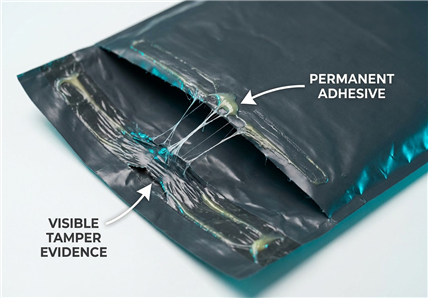
Tamper-evident poly mailers use a permanent hot-melt adhesive designed to bond aggressively to the polyethylene film after firm pressure is applied. If someone tries to reopen the flap, the film, flap, or seal line should stretch, tear, or leave adhesive residue. The goal is not to make a package impossible to open; the goal is to make unauthorized opening visible.
Internal Seal-Test Observation
In one internal handling test, we gave 50 participants sealed tamper-evident mailers and asked them to open the bags without leaving visible evidence. Participants were not allowed to cut through a separate side edge; the test focused on the sealed flap area.
49 attempts left visible tearing, stretching, or flap damage.
1 attempt left adhesive strings across the seal area.
0 attempts were resealed cleanly enough to look unopened during visual inspection.
This type of test is useful because it reflects a real-world deterrent: if tampering leaves visible evidence, the package is harder to pass off as untouched.
Why Opaque Film Matters for Secure Shipping
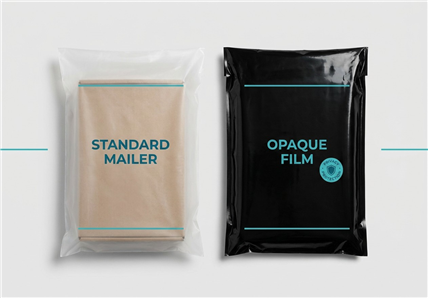
Tamper evidence addresses the opening problem. Opaque film addresses the selection problem. If a mailer is semi-transparent and shows the outline of a shoe box, tablet case, cosmetic kit, or branded product packaging, the shipment may attract more attention during handling.
Our opaque mailers use a co-extruded multi-layer film. One inner layer is formulated to block visible light, so the product shape and color are not easily seen under normal warehouse lighting or a flashlight.
In a simple light-blocking comparison, we placed a bright red garment inside a standard dark gray mailer and inside an opaque co-extruded mailer. Under bright light, the standard bag showed a visible silhouette. The opaque bag did not reveal the garment color or outline.
For e-commerce fulfillment, this matters for three reasons:
Customer privacy: neighbors, drivers, and handlers cannot easily see what is inside.
Lower selection risk: handlers have less visual information when deciding which parcels are worth targeting.
Operational confidentiality: competitors or third-party handlers cannot easily identify product mix from package outlines.
Client Example: Sneaker Brand Reduces Missing-Item Claims
In one anonymized 2026 client project, a DTC sneaker brand shipping about 15,000 orders per month switched from standard poly mailers to opaque tamper-evident poly mailers for selected outbound shipments.
Before the switch, the brand reported a 2.1% missing-item claim rate, mostly associated with mid-transit handling rather than confirmed porch theft. During the first 90 days after the switch, the claim rate dropped to 0.4%. The incremental packaging cost was about $0.03 per bag.
Methodology note: the claim rate was calculated as missing-item claims divided by total outbound shipments in the tracked lane group. Cases with clear final-mile delivery theft indicators were excluded where carrier data allowed. The client data was anonymized and shared with permission. Results vary by carrier, product value, shipping lane, and packing process.
The same client also reported fewer customer complaints about packages that “looked opened” on arrival. Their support team estimated about 12 fewer hours per week spent on theft-related claim handling after the new mailers were introduced.
Thickness Guide: Match the Bag to the Product
A tamper-evident seal only performs well when the bag itself is strong enough for the product and shipping lane. Over-specifying the film increases plastic use and cost. Under-specifying it can lead to tearing on conveyors or during manual handling.
Product Weight | Recommended Gauge | Typical Use |
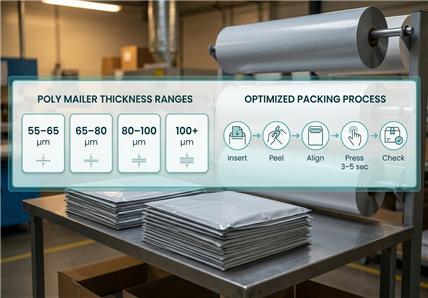
Under 500 g | 55–65 microns | T-shirts, accessories, documents |
500 g – 2 kg | 65–80 microns | Hoodies, small electronics, single-pair shoes |
2 kg – 5 kg | 80–100 microns | Multiple garments, boxed items, small appliances |
Over 5 kg | 100+ microns or custom structure | Industrial items, bulk goods, high-value electronics |
Before placing a large order, test 10–20 sample bags on your actual packing line. Check seal pressure, label adhesion, barcode scanning, conveyor movement, and whether the packed product creates stress points at the corners.
Color Coding: Branding Plus Fulfillment Control
Colored tamper-evident poly mailers wholesale are often used for branding, but in high-volume fulfillment they can also reduce operational errors.
Use one color for a warehouse zone to reduce picking and packing confusion.
Assign colors by carrier, such as blue for FedEx lanes and red for USPS lanes, to help reduce missorts.
Use a distinct return-mailer color so return packaging is not accidentally used for outbound shipments.
If you need custom-colored tamper-evident bags, confirm two details with the supplier: the pigment should be integrated into the film structure for consistent opacity, and the adhesive should still be permanent hot-melt. Color alone does not make a mailer tamper-evident.
Pack-Line Integration: No New Equipment Required
For most fulfillment teams, tamper-evident biodegradable poly mailer can replace standard peel-and-seal bags without new machinery. The packing process is almost the same, but the seal-pressure step matters more.
Insert the product and keep sharp corners away from the seal area.
Peel the release liner completely.
Fold the flap straight and align the seal before contact.
Apply firm pressure across the full flap for 3–5 seconds.
Visually check that the flap is flat, sealed, and free of dust or trapped air.
A new packer can usually learn the process in about 15 minutes. We recommend posting a one-page SOP with photos at the packing station, especially during the first week after switching bags.
Storage tip: keep bags flat and away from direct heat, humidity, and sunlight. Use FIFO rotation. Typical adhesive shelf life is 12–18 months from manufacture, depending on storage conditions.
FAQ: Questions Buyers Ask Before Switching
Can I use tamper-evident poly mailers for international shipping?
Yes. Customs officials may open packages for inspection, but a tamper-evident mailer will usually show visible damage after opening. Some brands include a note inside the package: “If this bag appears opened, please inspect contents before accepting.”
Does opaque film affect barcode scanning or label readability?
No. The opacity layer is inside the film structure. The outer surface remains suitable for thermal labels, printed shipping labels, and barcode scanning when labels are applied correctly.
What is the MOQ for custom-colored tamper-evident bags?
For custom colors, the typical MOQ is 10,000–20,000 pieces, depending on size, film structure, and printing needs. Lower MOQs may be available for standard colors such as white, black, or gray.
Can I get samples before ordering in bulk?
Yes. We recommend sample testing before bulk ordering. Share your product size, weight, and shipping lane, and we can suggest a sample pack for your packing-line test.
Are these bags suitable for food-contact or medical use?
Standard tamper-evident shipping bags are not food-grade by default. Food-contact or medical-device packaging requires separate material, documentation, and production requirements. We can discuss FDA, EU food-contact, or ISO 13485-related requirements case by case.
Request Samples and a Quick Specification Check
If you are comparing secure shipping bags, start with a small pack-line test rather than a blanket quote. Send us:
Typical product weight and dimensions
Monthly order volume
Main shipping lanes, such as US domestic, EU domestic, or cross-border fulfillment
Preferred color, thickness, and printing requirements, if known
We will reply with a recommended gauge, adhesive specification, sample suggestion, and pricing per 1,000 bags at your estimated volume.
Request free samples and a quick quote, or email postmaster@zoyuepack.com and mention “tamper-evident blog” for faster handling.
Oven Zhong
I’ve spent over 20 years deeply rooted in the packaging industry, learning the craft from the ground up within my family’s business. Today, as the founder of ZoyuePack, I’m known by colleagues and competitors alike as the "Packaging Brother"—a title I wear with pride because I believe in collaboration over mere competition. You’ll often find me on the factory floor filming videos to demystify the science of LDPE versus compostable materials. For me, ZoyuePack isn't just a faceless corporation; it’s a platform where I can educate, share candid industry insights, and help you tell your brand’s story through sustainable, innovative packaging.
 English