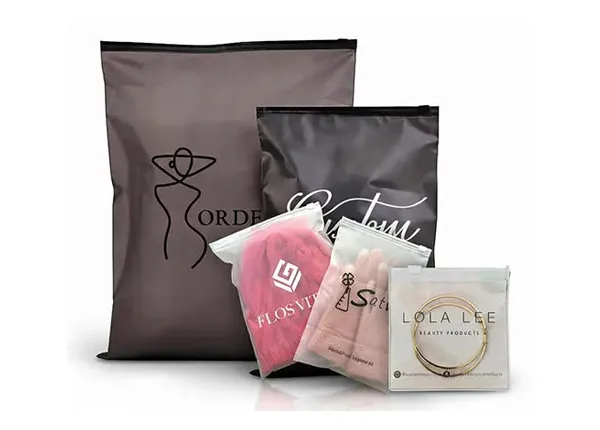
A poly mailer can look perfectly fine when it is empty and still be wrong for the job.
If the film is too light for the product, sharp corners may stretch the bag, the surface may scuff during handling, or the seal area may carry more stress than expected. If the mailer is heavier than the shipment needs, the buyer may be paying for material that adds little practical value.
That is why poly mailer thickness should not be chosen by habit alone. The right specification depends on the product's weight and shape, the level of handling it will face, the shipping route, the desired brand presentation, and the buyer's budget.
At ZoyuePack, we produce three commonly requested poly mailer specifications:
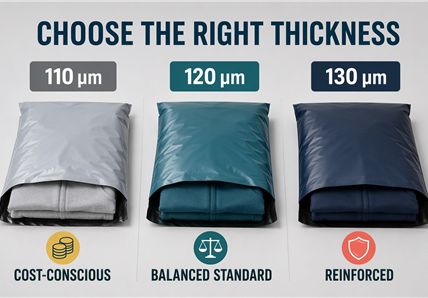
-- 110 microns: A cost-conscious option made with semi-virgin material, positioned for middle- and entry-level requirements;
-- 120 microns: Our standard poly mailer specification, made with virgin material and selected for balanced everyday performance;
-- 130 microns: A reinforced virgin-material option for buyers who want a heavier feel and additional durability.
This guide explains the advantages, relative cost, limitations, and typical applications of each option.
Thickness Unit Conversion Table
Mil | Micron | Millimeter |
0.30 | 7.6 | 0.0076 |
0.35 | 8.9 | 0.0089 |
0.40 | 10.2 | 0.0102 |
0.45 | 11.4 | 0.0114 |
0.50 | 12.7 | 0.0127 |
0.55 | 14.0 | 0.0140 |
0.60 | 15.2 | 0.0152 |
0.65 | 16.5 | 0.0165 |
0.70 | 17.8 | 0.0178 |
0.75 | 19.1 | 0.0191 |
0.80 | 20.3 | 0.0203 |
0.85 | 21.6 | 0.0216 |
0.90 | 22.9 | 0.0229 |
0.95 | 24.1 | 0.0241 |
1.00 | 25.4 | 0.0254 |
1.10 | 27.9 | 0.0279 |
1.20 | 30.5 | 0.0305 |
1.30 | 33.0 | 0.0330 |
1.40 | 35.6 | 0.0356 |
1.50 | 38.1 | 0.0381 |
1.60 | 40.6 | 0.0406 |
1.70 | 43.2 | 0.0432 |
1.80 | 45.7 | 0.0457 |
1.90 | 48.3 | 0.0483 |
2.00 | 50.8 | 0.0508 |
What Does Poly Mailer Thickness Affect?
Film thickness is one part of a poly mailer's performance. As thickness increases within the same material system and production quality, the bag generally feels more substantial and can offer more resistance to stretching, punctures, and rough handling.
Thickness can influence:
The hand feel of the empty and packed mailer
Resistance to stretching around product corners
Puncture and tear resistance
Opacity and privacy
Seal-area stability
Printing appearance
Material use and unit cost
The customer's perception of packaging quality
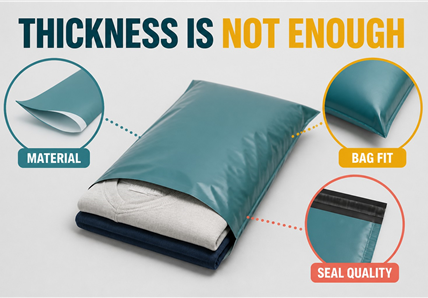
However, thickness does not work alone. A well-made 120-micron mailer may perform more reliably than a poorly processed thicker bag. Resin formulation, film uniformity, co-extrusion quality, side seals, adhesive, printing, bag size, and packed-product shape all matter.
For this reason, buyers should compare complete samples rather than judging a bag only by the number shown on a quotation.
Quick Comparison: 110 vs. 120 vs. 130 Microns
Specification | Material Positioning | Main Advantage | Relative Cost | Typical Fit |
110 microns | Semi-virgin material | Lower material cost for less demanding shipments | Lowest of the three | Lightweight, soft, non-fragile products and budget-focused programs |
120 microns | Virgin material | Balanced strength, appearance, and cost | Mid-range | Standard e-commerce apparel and general-purpose shipping |
130 microns | Virgin material | Heavier feel and added resistance for demanding use | Highest of the three | Premium brands, heavier soft goods, longer routes, or products that place more stress on the film |
The table is a practical guide rather than a performance guarantee. Final suitability should be confirmed with the actual product and packed sample.
110 Microns Thickness Poly Mailers: A Budget-Focused Option
ZoyuePack's 110 microns poly mailers use semi-new material and are positioned for buyers whose priority is controlling packaging cost for relatively low-risk products.
1) Advantages of 110 Microns
The main benefit is material efficiency. Compared with the 120 and 130 microns options, the lighter specification uses less material and normally carries a lower unit cost when the bag size, printing, quantity, and other features remain comparable.
It can be a sensible option when:
The packed item is lightweight and flexible
The product has no hard or sharp corners
The mailer is not expected to carry heavy internal stress
The delivery route is relatively straightforward
The buyer needs a practical bag rather than a premium hand feel
Packaging cost is a major purchasing consideration
2) Points to Consider
The lower material cost comes with trade-offs. A 110 microns poly mailer may feel lighter and may not provide the same appearance, film consistency, or resistance as a thicker option.
For the right product, 110 microns can be economical. Using it for the wrong product can lead to overstretching, punctures, or a package that feels below the brand's intended position.
120 Microns Thickness Poly Mailers: ZoyuePack's Standard Specification
For most general-purpose e-commerce projects, ZoyuePack recommends 120 microns as the standard starting point. These mailers use virgin material and are designed to balance durability, appearance, packing efficiency, and cost.
1) Advantages of 120 Microns
Compared with the 110 microns semi-new option, the 120 microns mailer offers a more consistent base for film appearance, printing, strength, and repeat production.
Its main advantages include:
A balanced hand feel for everyday e-commerce shipping
Better resistance to stretching than the lighter option
Suitable support for common apparel and textile orders
A clean surface for custom printing
Dependable opacity when the color and film structure are correctly specified
Moderate material use without moving to the heaviest option
2) Cost Position
The 120 microns option normally sits between the other two specifications in material cost. It costs more than the 110 microns version but provides virgin-material positioning and a stronger overall presentation. It uses less material than the 130 microns version, making it a balanced option when reinforcement is not necessary.
For many buyers, this middle position simplifies purchasing: the bag feels appropriate for routine fulfillment without over-specifying every shipment.
3) Points to Consider
A standard specification is not suitable for every product. Mailers carrying heavy boxed goods, sharp corners, or unusually demanding routes may need a thicker structure, a different film formulation, an inner protective layer, or a box instead.
Testing remains important, particularly when a brand changes product size, packing quantity, or shipping route.
130 Microns Thickness Poly Mailers: Reinforced for a More Substantial Feel
The 130 microns option uses virgin material and is intended for buyers who need more reinforcement or want the package to feel heavier and more premium.
The extra thickness does not turn a flexible mailer into a rigid protective box. It does, however, provide more material around the product and can improve resistance to stretching and puncture under comparable conditions.
1) Advantages of 130 Microns
The main benefits include:
A thicker, more substantial hand feel
Added resistance when products place more stress on the film
Stronger premium positioning at the point of delivery
Better suitability for heavier soft goods and larger mailer sizes
Additional confidence for repeat handling, sorting, and longer shipping routes
A robust base for high-quality custom printing
2) Cost Position
Among the three options, 130 microns uses the most material and normally has the highest unit cost when other specifications remain equal. It may also add a small amount of packaging weight across high-volume shipments.
The extra cost is easier to justify when it supports a real requirement: heavier contents, rougher handling, larger bag dimensions, fewer packaging failures, or a more premium customer experience.
If the product is a lightweight T-shirt and the route is low risk, the additional material may offer limited value. Thickness should solve a packaging problem, not simply make the specification sound stronger.
3) Points to Consider
A thicker mailer may be less flexible and can require different handling at the packing station. Seal pressure, adhesive performance, side-seal quality, and packed dimensions should all be checked.
Buyers should also consider whether a rigid mailer box or protective inner packaging would be more appropriate for products that are truly fragile. Increasing film thickness cannot replace structural protection.
Material Quality Matters as Much as Thickness
Comparing micron numbers without comparing materials can be misleading.
A buyer should confirm:
Thickness tolerance across the film
Opacity and color consistency
Odor requirements
Tensile and puncture performance where relevant
Side-seal strength
Adhesive type and flap design
Print adhesion and rub resistance
Does a Thicker Poly Mailer Always Protect Better?
Not necessarily.
A thicker film can offer more resistance, but performance can still be weakened by:
Poor side seals
Uneven film thickness
An undersized bag stretched tightly around the product
Weak adhesive or incomplete flap pressure
Sharp product corners
Rough handling beyond the package's intended use
Unsuitable material formulation
Incorrect storage conditions before use
A correctly sized 120 microns poly mailer may perform better than a 130 microns shipping bag that is too tight or poorly sealed. Size, structure, and workmanship need to support the thickness specification.
How to Test the Right Thickness Before Ordering
For a new product, test filled bags rather than empty samples.
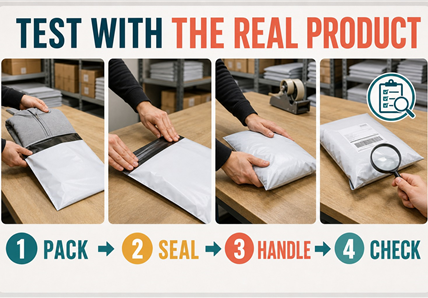
A practical test should include:
1) Pack the actual product using the normal folding or retail packaging method
2) Check whether the bag is easy to load without excessive stretching
3) Apply the adhesive flap using the planned packing procedure
4) Inspect corners, side seals, and the flap after handling
5) Compress and move the parcel as it would be handled in a warehouse
6) Test label adhesion and barcode scanning
7) Review opacity, print appearance, and overall hand feel
8) If possible, send trial parcels through the real shipping route
9) Compare 110, 120, and 130 microns using the same bag size and product
10) Record the approved material, thickness, size, color, print, seal, and tolerance for repeat orders
Testing makes the cost decision easier because the buyer can see whether the heavier option produces a useful improvement.
ZoyuePack Offers All Three Thickness Options
ZoyuePack produces 110, 120, and 130 microns thickness poly mailers for different purchasing needs.
1) 110 Microns: Cost-Conscious
Our 110 microns semi-new option is intended for lightweight, low-risk products and buyers who need to control material cost. It serves middle and entry-level packaging requirements when the application has been properly tested.
2) 120 Microns: Standard and Balanced
Our 120 microns virgin-material option is the ZoyuePack standard specification for many general poly mailer projects. It balances strength, appearance, printing, material use, and everyday fulfillment cost.
3) 130 Microns: Reinforced and More Premium
Our 130 microns virgin-material option is designed for heavier or more demanding applications and brands that want a thicker, more substantial package.
Because we manufacture all three specifications, customers do not have to use one thickness for every product. A brand may choose 110 microns thickness for lightweight inner packaging, 120 microns thickness for its regular apparel orders, and 130 microns thickness for premium collections or heavier multi-item shipments.
Our team can review the product, bag size, material preference, printing, route, quantity, and budget before preparing samples or a quotation.
Conclusion
The best poly mailer is not automatically the thickest one. It is the lightest specification that can reliably protect the product, support the packing process, and match the brand's presentation requirements.
Choose 110 microns when the shipment is light, flexible, low risk, and cost sensitive. Choose 120 microns when you need ZoyuePack's balanced standard virgin-material specification for general e-commerce use. Choose 130 microns when additional film strength, a heavier feel, or premium positioning provides a practical benefit.
If you are deciding between these thicknesses, send ZoyuePack your packed product dimensions, weight, shipping route, artwork, quantity, and target price position. We can help compare all three options and prepare a thickness solution for your regular, budget, and premium packaging needs.
Oven Zhong
I’ve spent over 20 years deeply rooted in the packaging industry, learning the craft from the ground up within my family’s business. Today, as the founder of ZoyuePack, I’m known by colleagues and competitors alike as the "Packaging Brother"—a title I wear with pride because I believe in collaboration over mere competition. You’ll often find me on the factory floor filming videos to demystify the science of LDPE versus compostable materials. For me, ZoyuePack isn't just a faceless corporation; it’s a platform where I can educate, share candid industry insights, and help you tell your brand’s story through sustainable, innovative packaging.
 English